Ultrasonic Cleaning Frequency Selection Guide for Industrial Parts
August 28, 2026
Large Industrial Ultrasonic Cleaners for Heavy Loads: Tank Sizing, Handling, and Throughput
If you’re evaluating ultrasonic cleaning for your heaviest, most dimensionally demanding parts, the real question is whether a given system scales to your load. A tank sized for typical batch work will not necessarily handle an engine block, a die-cast tool, or an EV battery tray without losing cleaning consistency, damaging parts, or creating a safety problem on the shop floor.
This guide works through the engineering considerations that determine whether a large industrial ultrasonic cleaner can actually process your heaviest parts, rather than technically hold them.
Key Takeaways
- Size the tank to the largest part’s envelope plus 2 to 3 inches of clearance per face.
- Fixture design affects cleaning results as much as tank size.
- Manual loading breaks down past roughly 200 pounds.
- Large tanks need zoned generator control for consistent cleaning.
- High-mass parts pull heat out of the solution on contact.
Applications That Push Standard Ultrasonic Tanks to Their Limits
A handful of part categories consistently expose the limits of standard-capacity tanks:
- Engine blocks and large transmission housings (common in automotive remanufacturing), where mass and internal geometry both work against undersized systems
- Injection molds and die cast tooling, where toolroom maintenance teams need thorough cleaning of complex cavities without damaging precision surfaces
- Aerospace structural sections, where size and strict cleanliness specifications intersect
- EV battery trays and motor housings as North American EV manufacturing investment continues to grow
Each of these categories brings a different combination of weight, envelope size, and surface complexity, and each one demands oversized parts ultrasonic cleaning capacity rather than a system chosen because the part barely fits. Niagara Systems has built automotive parts washers and custom systems around exactly this kind of load for decades.
Tank Sizing: Industrial Ultrasonic Tank Sizing Is About Volume, Not Fit
The most common mistake in specifying industrial ultrasonic tanks is sizing to the part’s outer dimensions and stopping there.
Required internal volume starts with the largest part’s full envelope (length, width, and height), then adds clearance on every face: typically 2 to 3 inches per face from the tank wall, and the same clearance between parts when more than one is loaded per cycle.
That clearance gives the acoustic field the physical space to develop, and cavitation intensity builds gradually as sound waves propagate through the solution.
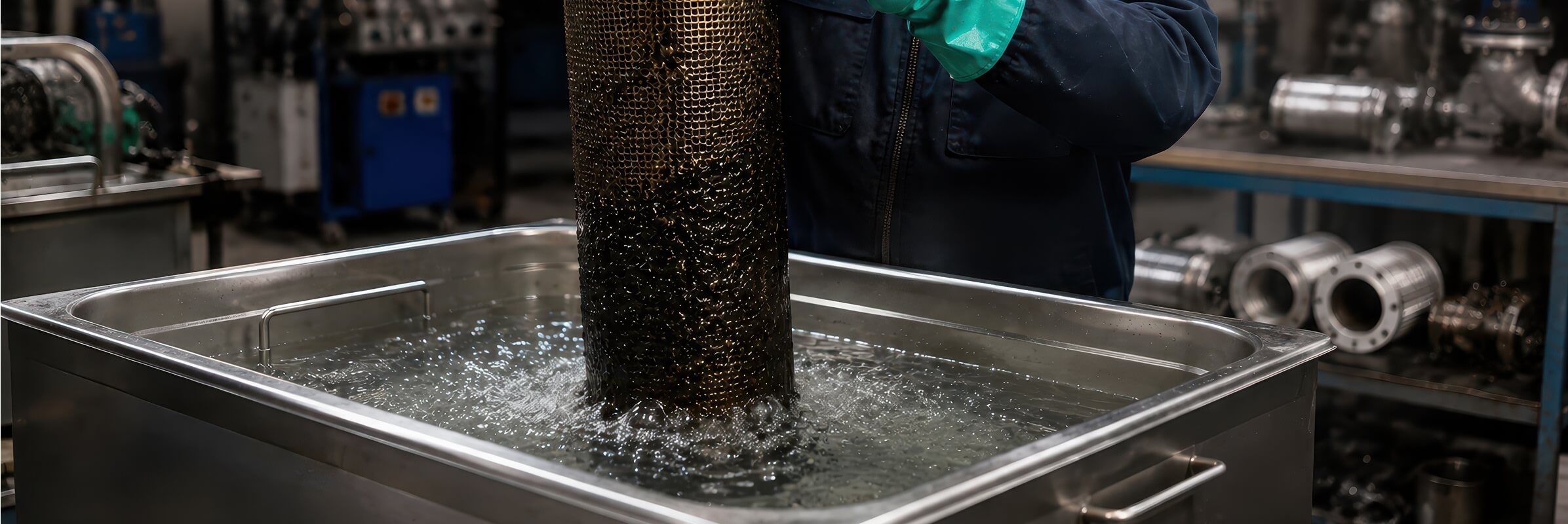
A part crowded against a tank wall, or against another part, sits in a zone where that field hasn’t fully formed. Those surfaces clean inconsistently, regardless of frequency or power density (covered in depth in our frequency selection guide). Oversizing the tank, beyond simply fitting the part into it, is what turns a high-capacity ultrasonic washer into an effective cleaning system.
This matters as much for die-cast tooling and injection mold components as it does for the metal parts most large-capacity systems are built around.
Basket and Fixture Design: Where Acoustic Shadows Hide
Getting tank volume right solves half the problem. The other half is how the part sits inside that volume. Baskets and fixtures have their own load capacity ratings, and exceeding them risks both structural failure and fixture deflection, which can shift parts into unplanned positions mid-cycle.
Rigid, fabricated baskets work well for consistent part families where the same geometry runs cycle after cycle. Adjustable fixtures make more sense for mixed production, where load configuration changes from job to job and a fixed basket would need constant rework.

What Is Acoustic Shadow?
The failure mode that catches most buyers off guard is the acoustic shadow.
Dense fixturing, overlapping parts, or a basket made of the wrong material can block ultrasonic energy from reaching recessed features entirely. This ends up leaving blind holes, ribs, and internal pockets contaminated, even though the exposed surfaces look clean.
Fixture design must account for line of sight to every critical surface, in addition to structural support. This is precisely the kind of problem Niagara’s custom washer division can solve, since stock fixturing rarely accounts for a specific part’s geometry and acoustic exposure needs at the same time.

Load Handling: Getting Heavy Parts In and Out Safely
Tank and fixture design only matter if parts can actually get in and out of the system without damage or injury. For heavy-duty ultrasonic cleaning systems handling loads in the hundreds of pounds, load handling becomes a design requirement on par with tank sizing.
Heavy parts typically move in and out of the tank using one of these methods:
- Overhead crane hard-points built into the tank framing
- Integrated hoist rails that travel the length of the system
- Robotic transfer for automated production lines
Manual Loading Breaks Down Past 200 Pounds
Manually loading parts that exceed roughly 200 pounds creates two separate problems. The first is the direct safety risk to operators. The second is a cleaning-consistency risk: manually placed loads are harder to position consistently relative to the tank walls and transducer faces.
A part that is placed even a few inches off position from one cycle to the next will not clean the same way twice, no matter how tightly every other variable is controlled.
Automation Solves High-Stakes Handling Problems
Automation pays off fastest when a part is too precise to process by hand. Read our nuclear fuel rod washing case study to see how we engineered a fully automated internal flushing and measurement system to hit micron-level tolerances that traditional washers couldn’t reach. The same engineering discipline applies to engine blocks and transmission housings on a remanufacturing line, though there the challenge is safe, repeatable handling rather than internal precision.
Acoustic Field Uniformity in Large Tanks
Large tanks introduce a problem that smaller systems don’t have to solve: maintaining consistent cavitation intensity across a much larger footprint. Transducer arrays in large industrial ultrasonic cleaners are typically bottom-mounted, side-mounted, or arranged in a dual-wall configuration, and the choice affects how evenly energy reaches every zone of the tank.
As tank footprint grows, a single generator struggles to maintain consistent watt-per-gallon output from one end of the tank to the other. Large systems typically run zoned generator control instead. Each zone gets its own generator output, tuned to maintain uniform intensity.
Part positioning relative to the transducer faces still matters within each zone; a part sitting directly over a transducer face and one sitting between two transducers can yield meaningfully different cleaning results, even within the same zone.
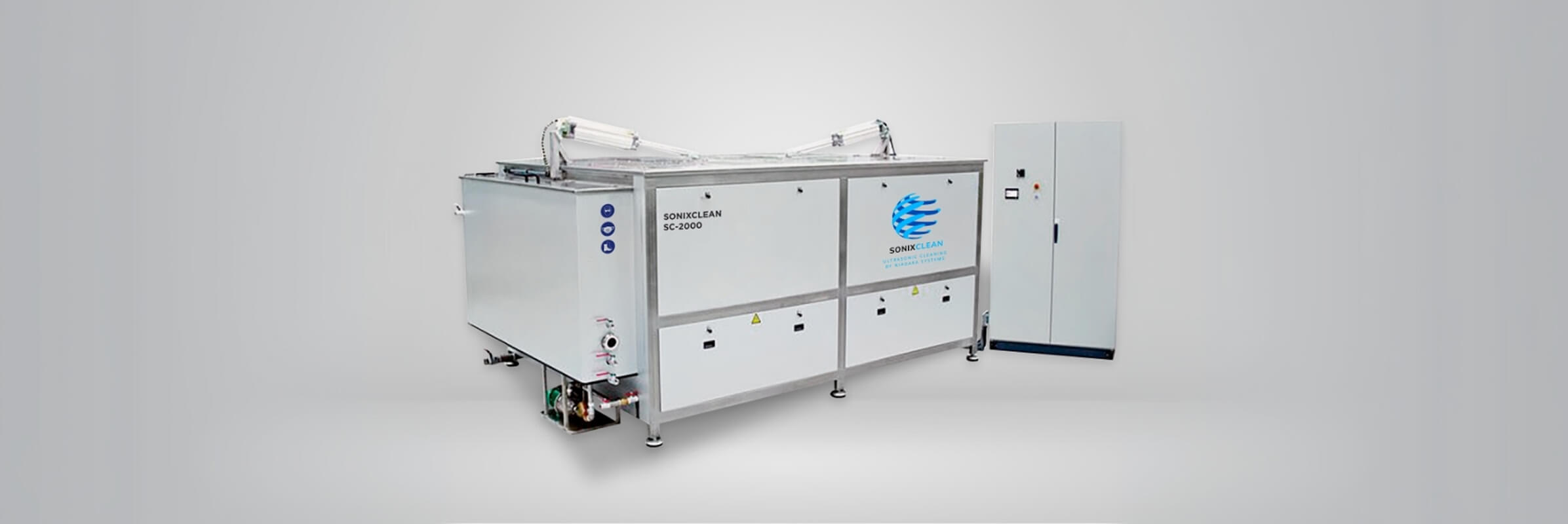
Niagara’s SonixClean ultrasonic systems are engineered with zone-by-zone uniformity in mind rather than treating a large tank as a scaled-up version of a small one.

Heat Management for High-Mass Loads
High-mass parts act as a heat sink. A room-temperature engine block or die-cast tool lowered into a heated bath pulls thermal energy out of the solution on contact. The more mass that enters the tank per cycle, the larger the thermal draw becomes.
Heat-up time for a given tank depends on solution volume, heater output, starting and target temperature, and the added thermal mass of the parts themselves. A heater sized correctly for an empty tank can fall short once it’s routinely absorbing heat from several hundred pounds of steel or aluminum every cycle. And that gap extends recovery time between loads and slows overall throughput.
Temperature uniformity matters just as much as reaching the target temperature in the first place. Most cleaning chemistries release soil more effectively within a specific temperature band. A tank that’s hot in one corner and cooler in another produces inconsistent results.
Checklist: Questions to Answer Before Specifying a Large-Capacity System
Before requesting a quote on a large-capacity ultrasonic system, work through these questions:
- What are the maximum part dimensions and weight across your full product mix, beyond your typical part?
- What clearance does your process require around the largest part, and does that match the 2 to 3-inch-per-face guideline?
- How will parts move in and out: crane, hoist rail, robotic transfer, or manual handling?
- What load rating does your fixturing need, and does your part geometry create acoustic shadows in recessed features?
- How much thermal mass are you introducing per cycle, and what heater capacity does that require?
- Do you need zoned generator control, multiple frequencies, or both to cover a mixed part family in one tank?
- What throughput do you need per hour or per shift, and how does load handling speed factor into that number?
Answering these before specifying a system is what separates a heavy-duty ultrasonic cleaner that performs from day one from one that needs rework six months in.
Start with an Engineering Assessment
Tank sizing, fixturing, load handling, acoustic uniformity, and heat management interact, so heavy-load ultrasonic cleaning is an engineering problem specific to your parts, not a spec pulled off a sheet. Browse our project gallery to see custom fixturing and large-capacity systems built for real heavy-load applications, then request a quote to start an engineering assessment of your application.
Frequently Asked Questions About Large Industrial Ultrasonic Cleaners
What is the maximum part weight an industrial ultrasonic cleaner can handle?
There is no universal ceiling. Maximum part weight is determined by the fixture’s load rating, the tank’s structural framing, and the capacity of the crane, hoist, or robotic transfer that moves the part. Custom-engineered systems routinely handle parts weighing several hundred to several thousand pounds when those components are specified for the load from the start.
Will heavy parts damage the transducers if they contact the tank bottom?
Yes. Direct or repeated contact between a part, basket, or fixture and the tank bottom can damage transducers and crack the diaphragm they’re mounted behind. The same 2- to 3-inch-per-face clearance used for tank sizing, plus basket standoffs and correctly rated fixturing, keeps parts from ever reaching the transducer faces.
How long does it take to heat a large ultrasonic tank when cleaning high-mass steel parts?
It depends on the solution volume, heater output, starting and target temperatures, and the thermal mass the parts add to the system. A heater sized for an empty tank will recover more slowly once it’s routinely absorbing heat from several hundred pounds of room-temperature steel or aluminum every cycle. Size the heater capacity based on your actual thermal mass per cycle, not tank volume alone.