Large Industrial Ultrasonic Cleaners for Heavy Loads
September 24, 2026
Single-Tank vs. Multistage Architectures: When to Specify Multistage Ultrasonic Cleaning Lines
Key Takeaways
- Your cleanliness standard is the main factor in choosing an architecture.
- A single tank is sufficient when cleanliness is checked visually or by weight.
- NVR, particle count, and ionic residue limits require a multistage line.
- In a counterflow rinse, the final stage receives the cleanest water.
- DI rinse water is required when parts have ionic residue limits.
- Multistage lines are most cost-effective at high, steady production volume.
The choice between single-tank and multistage ultrasonic cleaning depends on two factors: the cleanliness standard your parts must meet, and your required throughput. Cleaning power is a smaller factor. Both architectures can use the same transducers, so the main differences are in rinsing, residue control, and how well you can document the result.
This guide is for readers who have already selected ultrasonic cleaning and are comparing industrial ultrasonic cleaning systems. If you want the fundamentals first, read How Does Ultrasonic Cleaning Work?
You will learn when a single tank is enough, which requirements call for a multistage line, and how to qualify your own parts before you contact a manufacturer.
What a Single-Tank System Handles Well
A single-tank ultrasonic cleaning system performs soil removal and gross rinsing in a single tank. Drying, when needed, takes place at a separate station.
Single-tank ultrasonic cleaners are often sufficient for general industrial work. In these applications, cleanliness is checked visually or with simple gravimetric tests, and cycle times are flexible. Typical examples include general machining, fabrication, and remanufacturing work.
A single tank has one built-in limitation: contaminants removed from the part remain in the same bath. As oil and particles accumulate, some redeposit on later parts, and cycle times must increase to maintain the same result.
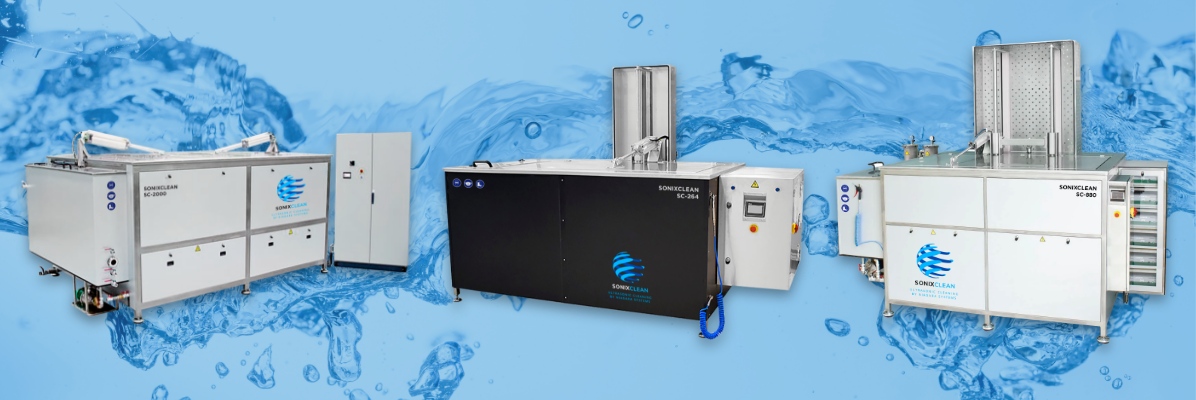
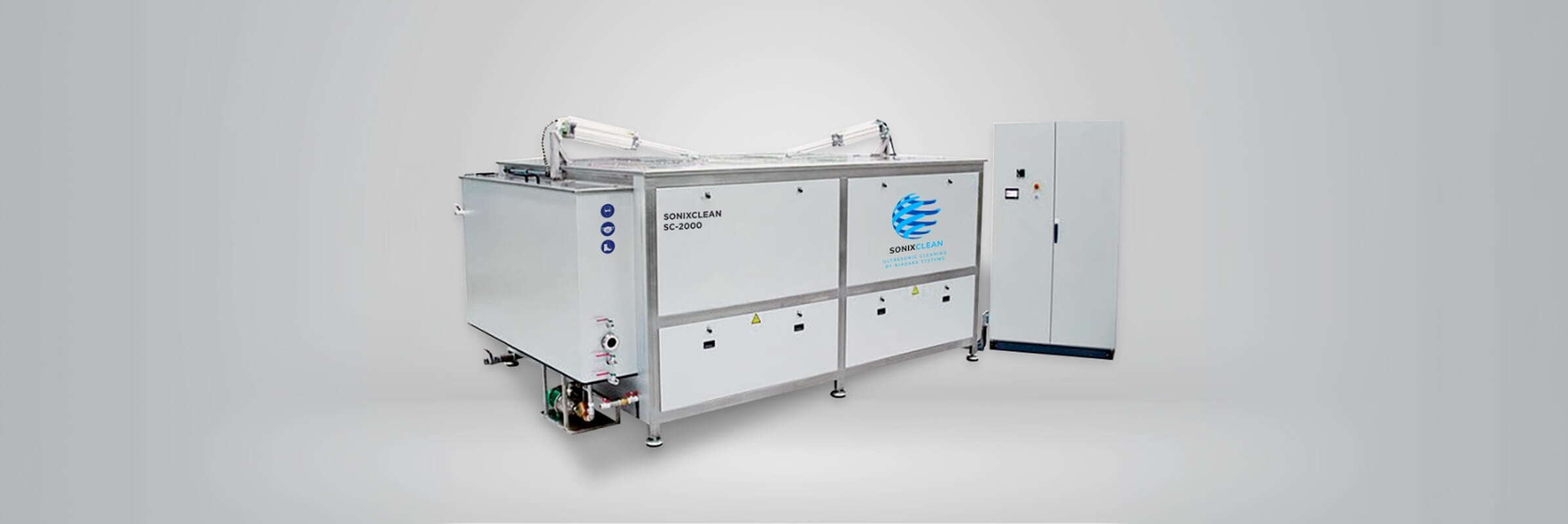
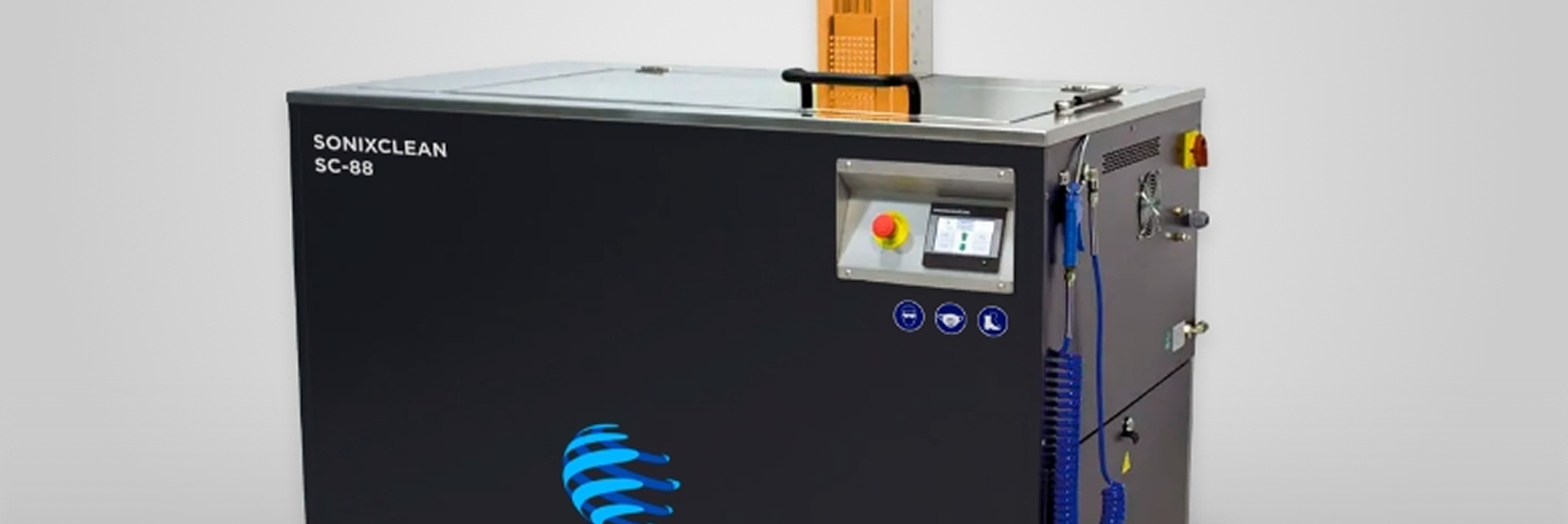
Niagara’s SonixClean ultrasonic systems include single-tank configurations ranging from compact batch units to production-scale tanks.
Cleanliness Metrics That Require a Multistage Line
Some specifications cannot be met in a single bath, even with well-designed ultrasonics. The following metrics are the most common:
- Non-Volatile Residue (NVR): NVR is the residue that remains on a surface after the rinse liquid evaporates. Limits are expressed as mass per unit area, often in mg/m².
- Particle Counts By Size Class: ISO 16232 and VDA 19 describe how to extract particles from a part and then count and size them. A specification sets a maximum particle size and count. Automotive manufacturers apply these standards to fuel, brake, and transmission components. Our guide to Millipore testing explains the extraction and gravimetric method behind many of these checks.
- Ionic Cleanliness: Electronics and some sensor assemblies have limits on ionic residue. Compliance is typically verified by measuring the conductivity of an extraction solution.
A single tank cannot meet these limits because the part is rinsed in the same bath that holds the removed contaminants. Single-tank applications rely on simpler checks, such as water break tests, dyne pens, and weighing parts before and after cleaning.
These methods are covered in our technical paper on cleanliness testing.
Counterflow Rinse Design
Counterflow rinsing allows a line to meet measurable cleanliness limits. Parts move forward through the line, from the wash tank through each rinse stage. Rinse water moves in the opposite direction.
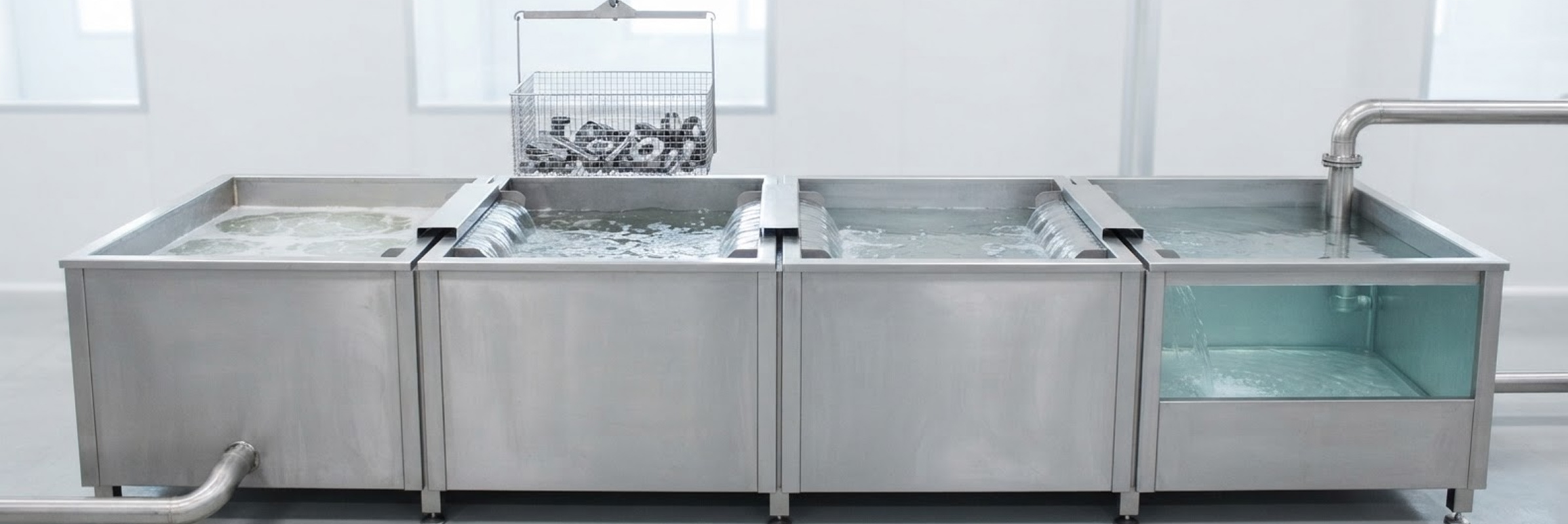
Fresh water enters at the final rinse stage and overflows into the stage before it. Each stage overflows into the previous one, and wastewater exits from the first rinse.
As a result, the final stage always contains the cleanest water. Each earlier stage holds a higher concentration of contaminants, so conductivity increases from the end of the line to the front.
This gradient prevents recontamination because each rinse a part enters is cleaner than the last. A counterflow rinse system also uses less water than supplying fresh water to every stage separately.
DI Water Management
Deionized (DI) rinse water is necessary when a part cannot tolerate dissolved minerals or ionic residue. Common examples include medical components, semiconductor hardware, and fuel system components. Tap water leaves spots and ionic films as it dries. A DI rinse ultrasonic stage prevents this.

A conductivity control loop maintains water purity, and a probe in the final stage measures conductivity continuously. When the reading exceeds the setpoint, the controller adds fresh DI water or alerts operators that the resin needs service. Final-stage targets are typically between 1 and 5 µS/cm, but your specification determines the actual value.
Adding DI water to a line requires the following equipment and support:
- A DI or reverse osmosis skid sized for peak rinse demand
- Pretreatment to protect resin from chlorine and hardness
- Resin exchange or regeneration, plus the associated labor and waste handling
- Floor space, plumbing, and drain capacity near the line
- Ongoing monitoring and probe calibration
Specify DI water only when the cleanliness standard requires it. For parts with particle limits but no ionic limits, a counterflow rinse with filtered water may be sufficient.
Typical Multistage Configurations
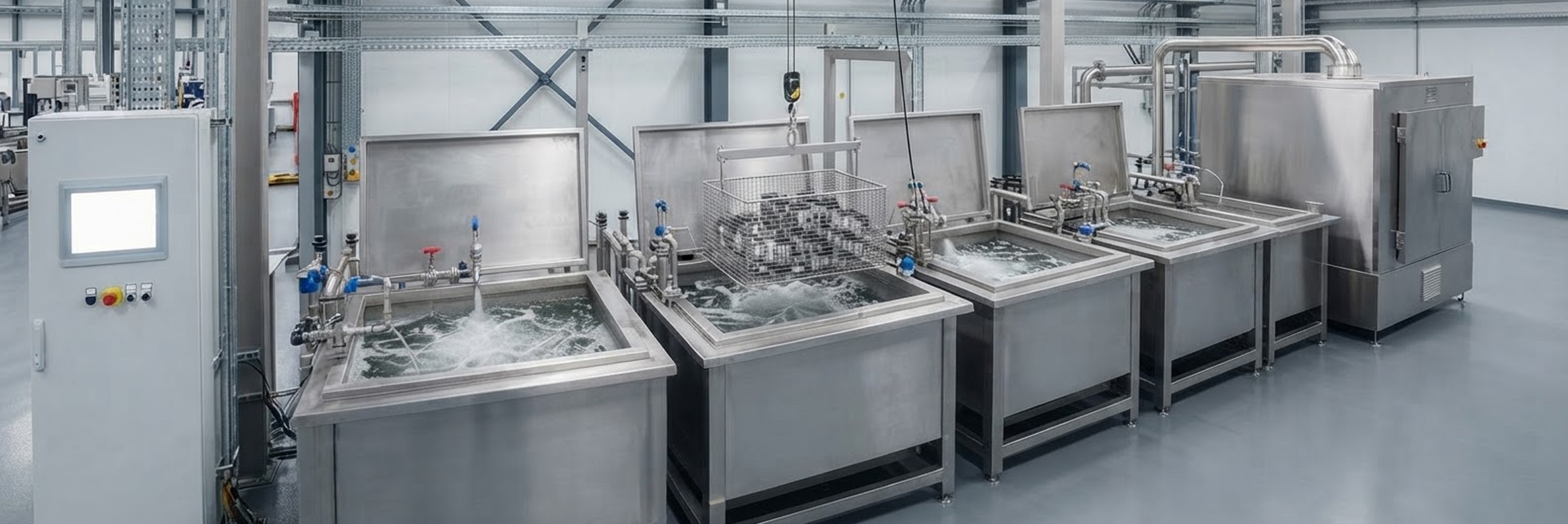
Multistage lines are built in several configurations. The number of stages depends on the cleanliness standard, the type of contaminants, and whether parts must be dry when they exit the line. Three-stage and five-stage lines are two of the most common designs.
Three-Stage: Wash, Rinse, DI Rinse
A three-stage line includes an ultrasonic wash tank, a standard rinse tank, and a DI rinse tank. This configuration is used for precision-machined parts with particle limits and strict residue requirements. Typical examples include valve bodies, hydraulic components, and medical components. If parts must be ready for assembly upon exiting the line, add drying equipment at the end.
Five-Stage: Wash, Intermediate Rinse, Ultrasonic Rinse, DI Rinse, Drying
A five-stage ultrasonic wash, rinse, dry line adds an intermediate rinse after the wash and an ultrasonic rinse before the DI stage. These additional stages remove more cleaning chemistry and particles before parts reach the final DI rinse. Drying is included as the last stage.
This configuration is used in applications with the strictest validation requirements. Examples include hydraulic and fuel components in aerospace parts cleaning, defense and military parts built to MIL-SPEC cleanliness requirements, and semiconductor chamber components.
Throughput and Footprint Trade-Offs
A multistage ultrasonic cleaner costs more and requires more floor space. The additional tanks, transfer equipment, and DI system all increase the footprint. Compare these costs against your production volume and cleanliness requirements. At high production volumes, the cost comparison changes:
- In a single tank, each step runs sequentially in the same bath. As contamination builds, cycle times increase to maintain the result, and the tank limits production.
- In a multistage line, each stage processes a different basket simultaneously. Throughput depends on the slowest stage rather than the total time of all stages. Parts exit the line rinsed, dry, and ready for the next operation.
The same factors apply when comparing a solvent tank with an aqueous ultrasonic line. A multistage aqueous line includes rinse stages, filtration, and drying that a single solvent tank does not, and its results are easier to document.
Single Tank or Multistage Line: Five Variables to Evaluate
Use this table to evaluate your application before you contact a manufacturer.
| Variable | A single tank fits when | A multistage line fits when |
|---|---|---|
| Target cleanliness standard | Visual inspection, gravimetric checks, or simple surface tests | NVR, particle size class, or ionic limits with documented validation |
| Production volume | Low to moderate batches with flexible cycle times | Sustained high volume with a fixed cycle time |
| Part geometry | Open shapes that drain easily | Blind holes, internal passages, or assemblies that need thorough rinsing |
| Available floor space | Floor space is limited | Space is available for multiple tanks and part handling |
| Budget | Capital is the main constraint | Throughput and yield justify higher capital |
If most of your answers match the right-hand column, request a quote for a multistage line. If your answers are mixed, start with the cleanliness specification, since it is usually the deciding factor.
Plan Your Ultrasonic Cleaning Line With Niagara Systems
The right architecture follows from your cleanliness standard, volume, and part geometry. Niagara Systems engineers will review those requirements with you and recommend a configuration that fits your parts, your floor space, and your budget. Request a quote to start the conversation with our team.
Frequently Asked Questions About Single Tank vs. Multistage Ultrasonic Cleaning
How often does the wash solution need to be replaced in a multistage ultrasonic line?
There is no fixed interval. Replacement depends on the amount of soil, the chemistry, and the filtration system. Monitor concentration, pH, and oil content, and replace the solution when cleanliness test results begin to decline. Filtration and oil separation extend the life of the solution.
Can a multistage line be designed to handle mixed part geometries in the same production run?
Yes, within limits. Custom fixtures, programmable cycle settings, and part rotation or oscillation help clean different shapes. The part with the strictest cleanliness requirement determines the process settings, so group parts with similar requirements together. Niagara’s custom washer engineering team designs systems for mixed loads.
What is the difference between an overflow rinse and a counterflow rinse in an ultrasonic cleaning line?
An overflow rinse supplies fresh water to a tank, and the excess overflows to drain. In this design, each stage uses its own fresh water supply. A counterflow rinse sends water through the stages in series, from the final rinse back toward the first. This reduces water use and keeps the cleanest water in the final stage.