Single‑Tank vs. Multistage Architectures
October 30, 2026

Industrial Ultrasonic Parts Cleaners for Automotive and Aerospace: What Manufacturers Need to Know Before Buying
Key Takeaways
- Ultrasonic cleaning reaches blind holes and internal passages on complex parts, where it has advantages over spray washing.
- Automotive buyers should look at carbon buildup, oil, and grease on parts such as injectors, pistons, and cylinder blocks.
- Aerospace buyers should focus on contaminants in turbine blades and other complex parts, where cleanliness requirements are strict.
- Size a system from parts per shift, part size and weight, and geometry, then consider a multistage line if parts must leave rinsed and dry.
An industrial ultrasonic parts cleaner removes oil, carbon, and fine particles from complex parts, including blind holes and tight internal features, where it has advantages over spray washing. Before you buy one, you need to know what it removes from your parts, how to size it to your volume, and which cleanliness records to ask the supplier for.
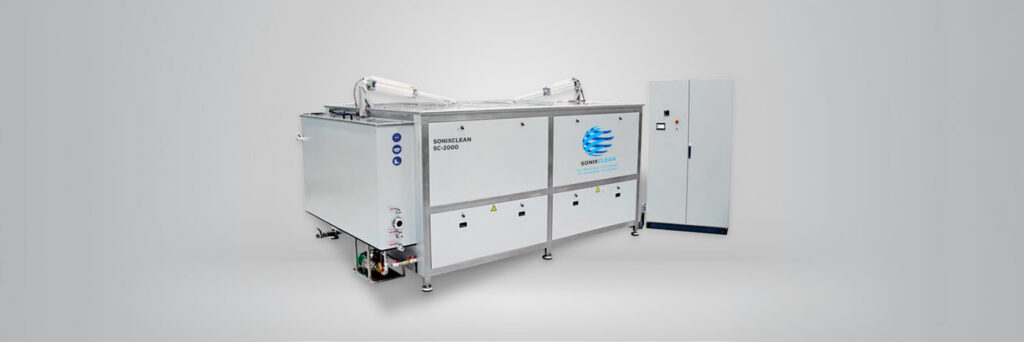
This guide covers automotive and aerospace parts. Niagara Systems has designed industrial parts washers since 1934, and its SonixClean ultrasonic cleaning systems are built in the USA.
If you want the fundamentals first, read How Does Ultrasonic Cleaning Work?
Article Contents
- What an Industrial Ultrasonic Parts Cleaner Removes That Other Methods Miss
- Automotive Parts: Carbon, Oil, and Residue in Injectors, Pistons, and Engine Blocks
- Aerospace Parts: Turbine Blades, Complex Geometries, and Strict Cleanliness Requirements
- How to Size an Ultrasonic Cleaning System to Throughput and Part Geometry
- Cleanliness Documentation and Traceability to Request From Your Supplier
- Frequently Asked Questions About Industrial Ultrasonic Parts Cleaners
What an Industrial Ultrasonic Parts Cleaner Removes That Other Methods Miss
An ultrasonic parts cleaner sends high-frequency sound waves through a liquid bath. The waves form microscopic cavitation bubbles that collapse against surfaces and reach into internal passages. Cleaning stays consistent and repeatable on features that other methods struggle with.
Niagara’s high-pressure spray systems use jets of cleaning solution and are suited to larger components such as engine housings. Ultrasonic cleaning has advantages over spray washing when parts have complex geometry or internal passages.
Ultrasonic cleaning removes three kinds of contamination from parts:
- Carbon buildup: baked-on deposits on engine parts.
- Oil and grease: residue from machining, assembly, and service.
- Particles and residue: fine debris held in blind holes and internal cavities.
On SonixClean systems, automated cycles replace manual scrubbing, and many models support programmable controls. That supports repeatable ultrasonic cleaning of metal parts.
Automotive Parts: Carbon, Oil, and Residue in Injectors, Pistons, and Engine Blocks
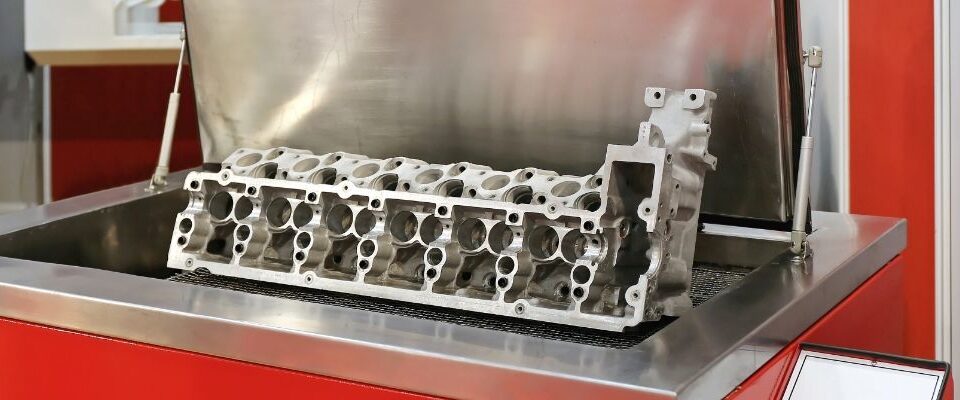
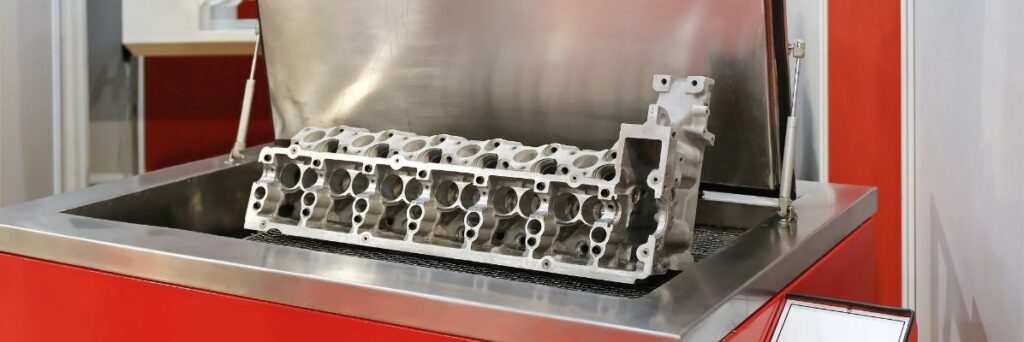
Automotive parts collect carbon build up, oil, and grease that ultrasonic cleaning can remove. Niagara’s automotive ultrasonic cleaning equipment cleans cylinder heads, cylinder blocks, crankshafts, pistons, turbocharger components, diesel injectors, and brake parts for OEM and aftermarket refurbishment work.

- Fuel injectors: Ultrasonic fuel injector cleaning suits parts with complex geometries, and diesel injectors are on the list of automotive parts Niagara cleans.
- Pistons: Niagara lists pistons among the parts it cleans. Fixturing and basket position affect how evenly cavitation reaches each part.
- Engine blocks and cylinder heads: Niagara cleans both. Engine blocks are heavy, so tank size and load handling matter for ultrasonic cleaning of engine parts.
Particles left in fuel and oil lines can hurt engine performance and increase wear. For that reason, automotive teams verify results with Millipore cleanliness testing after the wash.
Engine remanufacturing is one place these washers are used.
See how Niagara Systems supports remanufacturing and the wider automotive and transportation sector, or browse our automotive parts cleaners.
Aerospace Parts: Turbine Blades, Complex Geometries, and Strict Cleanliness Requirements
Aerospace components must be free of oil, grease, and carbon buildup that can create safety hazards. Aerospace parts cleaning is not a one-size-fits-all process, so the washer is built around your part and your requirements. Niagara designs its aerospace systems to FAA and MIL-SPEC requirements.

- Turbine blades: An aerospace ultrasonic cleaner suits complex geometries and internal passages, and Niagara names turbine blades as a good fit.
- Fuel injectors and fuel system parts: Niagara names fuel injectors among the parts that benefit from ultrasonic cleaning.
- Hydraulic components and gearboxes: Niagara names immersion tank cleaning as a fit for complex shapes and internal cavities, such as hydraulic systems and gearboxes.
Material matters too. Titanium and other delicate alloys often call for a gentler configuration, and some parts require two frequencies in a single cycle: one for machining residue and one for fine particulate. Niagara’s frequency selection guide explains how frequency and power are set together.
Defense programs have their own requirements, covered on the military parts washing page and the aircraft parts washers page. Niagara positions its enterprise SonixClean systems for large components and heavy loads, and the guide to large industrial ultrasonic cleaners for heavy loads covers tank sizing and load handling.
How to Size an Ultrasonic Cleaning System to Throughput and Part Geometry
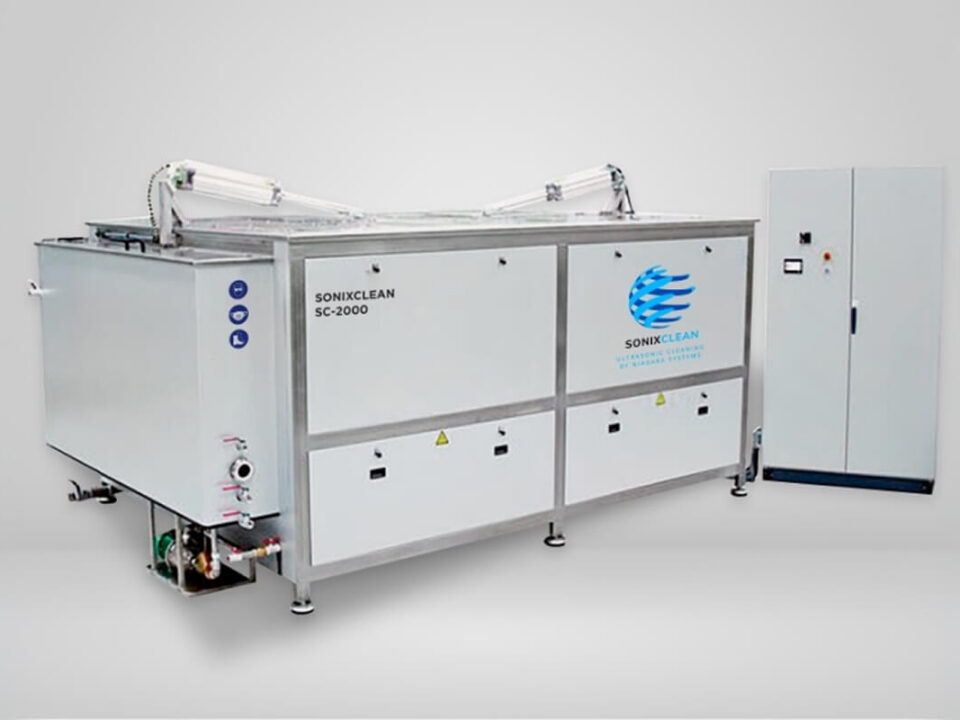
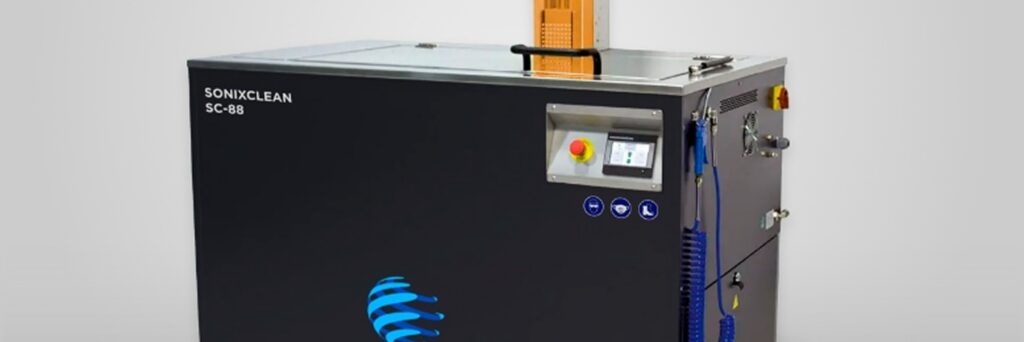
Size the system around your parts, your volume, and your facility. A tank sized for typical batch work will not necessarily handle your heaviest parts. Niagara’s SonixClean models cover small precision batch systems, mid-range batch systems, production-scale systems, and enterprise or custom solutions.
Throughput and Batch Size
Start with how many parts you must clean per shift. Higher production volumes may need larger tanks or faster cycle optimization.
- Count the parts that must be cleaned per shift.
- Divide that count by the number of parts that fit in one basket to get baskets per shift.
- Multiply by the cycle time from a trial on your own parts to get the tank hours you need.
If the result exceeds the hours in a shift, a larger tank or an automated ultrasonic cleaning system is the next step. Many SonixClean systems support automated cycles, programmable controls, and integration into production workflows.
Part Size, Weight, and Geometry
Larger and heavier components need more tank capacity and reinforced load handling. Fixture design affects cleaning results. Blind holes and internal passages need fixtures with line of sight to every critical surface. Basket position matters as well: rotating load position between cycles reduces the odds that the same critical surface lands in a weak zone every time.
Soil Type, Integration, and Facility Fit
Oil, grease, carbon, and embedded residue may influence the ultrasonic power a part needs. Decide early whether the system stands alone or joins a production line, and confirm electrical supply, floor space, and workflow layout. If your cleanliness limits call for separate rinse stages and drying, read Single-Tank vs. Multistage Architectures before you specify the line.
A Niagara Systems technical audit reviews your production needs and facility footprint with your team.
Cleanliness Documentation and Traceability to Request From Your Supplier
Ask for proof tied to the cleanliness requirement your parts must meet. Technical cleanliness for automotive components often references ISO 16232 and VDA 19, which describe how to extract and count particles, and aerospace programs set limits in their own specifications.
How Cleanliness Gets Verified
Millipore testing collects particles from a rinsed part onto a filter pad. Results are reported as particle size and count, or as weight after extraction. Niagara’s cleanliness test paper also covers water sheeting, dyne pens, and contact angle checks for surface condition.
Documents to Request
- Cleanliness specification and test method: the limit, the method, and the standard that method follows.
- Trial results on your parts: before and after data from a test on real parts, using particle count or weight.
- Lot or batch records: a plan for tying each cleaned lot to its test result and date.
- Process settings record: frequency, power, temperature, time, and chemistry for each part family, since these settings work together.
- Rinse and dry verification: confirmation that parts reach the dryness your next operation requires.
For aerospace and defense work, confirm which program requirements apply and who signs off on acceptance before you finalize the system.
Plan Your Ultrasonic Cleaning Process With a Niagara Systems Technical Audit
A Niagara Systems technical audit assesses your industrial washing needs for a new automation line, a washer replacement, or a retrofit. Niagara’s washing experts review your process, production needs, EHS improvements, and facility footprint, then help your team shape a solution for the project. Bring your parts list, volumes, and cleanliness requirements to the conversation.
Frequently Asked Questions About Industrial Ultrasonic Parts Cleaners
What shouldn’t go in an industrial ultrasonic parts cleaner without adjusting the settings?
Soft metals, polished surfaces, thin-wall components, and delicate alloys need adjusted settings before they go in. Aluminum and brass can pit or dull when cavitation power is too high for the material. Frequency, power, and cycle settings are chosen together around the part, so confirm settings against your actual parts.
How often should ultrasonic cleaning solution be changed?
There is no fixed interval. Change the solution when cleanliness test results begin to decline, which depends on the soil each load brings in, the chemistry, and the filtration. Concentration, pH, and oil content are worth monitoring. Filtration and oil separation extend solution life.
Do parts need to be rinsed and dried after ultrasonic cleaning?
Rinsing and drying depend on your requirements. Rinsing removes cleaning chemistry and loosened soil, and drying removes moisture that can cause corrosion, packaging problems, or delays in the next operation. Parts can be visibly dry or bone dry, and your requirement sets which one applies. Parts with particle or ionic limits usually need rinse stages built for that limit.